
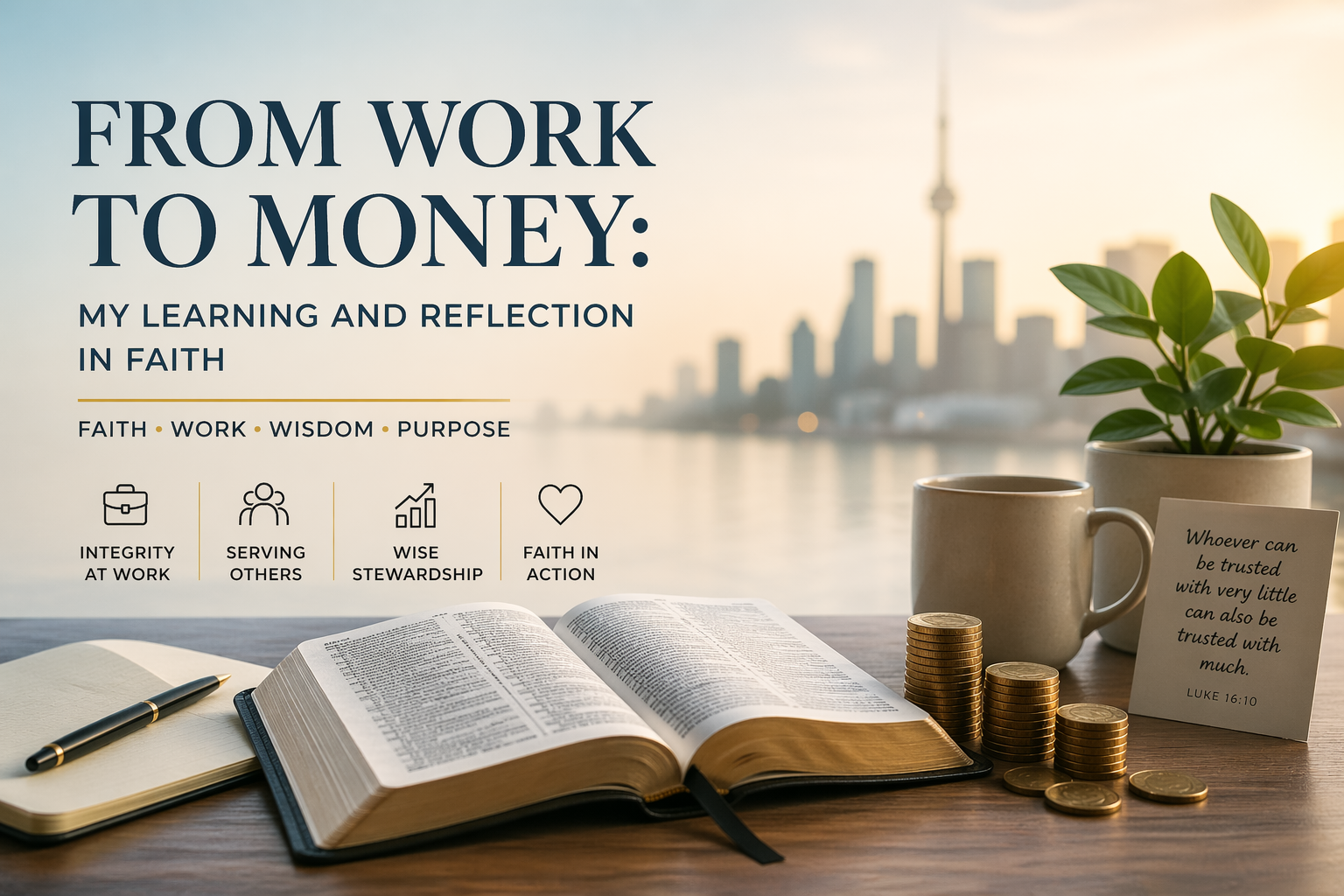
Recently, I completed a course at the School of Theology Toronto called “The Power of Wealth.” It gave me an opportunity to reflect more deeply on the role of money—not only in theory, but also in my daily work.
For those who know me, you may already know that I am a follower of Jesus. In my practice, I aim to integrate meaningful values into how I serve my clients. While some of my clients are fellow Christians, many are not. Regardless of background, I believe these principles are relevant and beneficial to everyone.
As part of the course, I was required to submit an essay reflecting on money, work, and faith. I would like to share it here to provide a clearer picture of how I approach my work and the principles that guide my practice.
1. The Nature and Impact of Money (Is It Evil?)
Many people believe that money is evil. Some even think that money itself causes people to become bad. However, I believe this is a misunderstanding.
Money itself is neither good nor evil. It is simply a tool. Just like a knife, it can be used to cook a meal or to hurt someone. The knife itself is not evil—the key lies in how it is used. The same applies to money. It does not carry moral value on its own; it depends on how people use it.
In real life, money plays an important role. It helps us meet basic needs such as food, housing, and daily expenses. For example, as a father and a husband, money allows me to provide for my family and fulfill my responsibilities. At the same time, I can also use money to help people around me and support those in need, making money a blessing.
However, money can also have negative effects. When people place too much importance on money, they may focus only on profit and ignore principles and the needs of others. In such cases, the issue is not money itself, but a problem with the human heart.
Therefore, the real problem is not money, but the heart. As the Bible says, “the love of money is a root of all kinds of evil” (1 Timothy 6:10). The key issue is not money, but the love of money. What we need to reflect on is how we view money and what place it holds in our lives.
2. Earning Money the Right Way (Principles of Integrity)

Since money itself is not the problem, the next important question is: how should we earn money?
In society, we earn income by providing products or services to meet the needs of others. In this area, I believe we can learn from God’s teachings.
The Bible speaks of many promises of God, and these promises never fail. I understand these promises as commitments—almost like a contract. When God makes a promise, He fulfills it. This shows that commitment is something serious.
Therefore, when we make commitments in our roles, we should treat them with the same seriousness. We should act with honesty and fairness, and maintain clear principles and boundaries to ensure we fulfill our responsibilities.
This applies to all professions. Whether one is a lawyer, doctor, financial professional, athlete, politician, or anyone in any field, everyone should work with integrity and responsibility.
In reality, earning money is often connected to business activities, so it is important to consider our values in business.
Is Business About Being Dishonest?
There is a common saying: “There is no honest business.” It suggests that being too honest makes it hard to succeed. I strongly disagree.
First, we need to define what dishonesty really is. If someone promises a product or service but cuts corners or fails to deliver, that is true dishonesty. However, such behavior only brings short-term gain and cannot last. Once trust is broken, it is very difficult to rebuild.
As the Bible says, “There is nothing concealed that will not be disclosed” (Luke 12:2). Dishonesty will eventually be exposed. While it may seem beneficial in the short term, it leads to long-term loss.
On the other hand, if we operate with honesty, fairness, and responsibility, and truly care for others, we can build trust and long-term relationships. This not only leads to stable growth but also aligns with Christian values.
Of course, business is not about avoiding profit. A business that does not generate profit is simply a hobby, not something sustainable. Profit is necessary for a business to continue operating and to provide value to society.
In my case, I have some personal experience to share. I have worked in the financial industry for over twenty years as a financial advisor. When I first started, I did not think much about integrity or principles. My goal was simply to grow my business.
However, after I came to know Jesus, I began to learn to base my work on His teachings. At church, an elder lent me a book that introduced the concept of servant leadership. This led me to reflect on how I should live out Jesus’ teachings in my work.
When working with clients, I began to communicate honestly and put their needs and suitability first, instead of focusing mainly on my own benefit.
As I practiced this, I found that trust gradually grew. My relationships with clients became stronger. This did not harm my business—in fact, it helped it grow steadily.
Looking back, I have now surpassed my original goals by more than double. I have also experienced how God continues to provide for my needs, allowing me to grow my business without compromising my principles.
Therefore, in developing a business, we must maintain both integrity and wisdom. As the Bible teaches, “be as shrewd as snakes and as innocent as doves” (Matthew 10:16). This reminds us to be wise in real situations while remaining upright and good.
3. How We Use Money (The Role of a Steward)
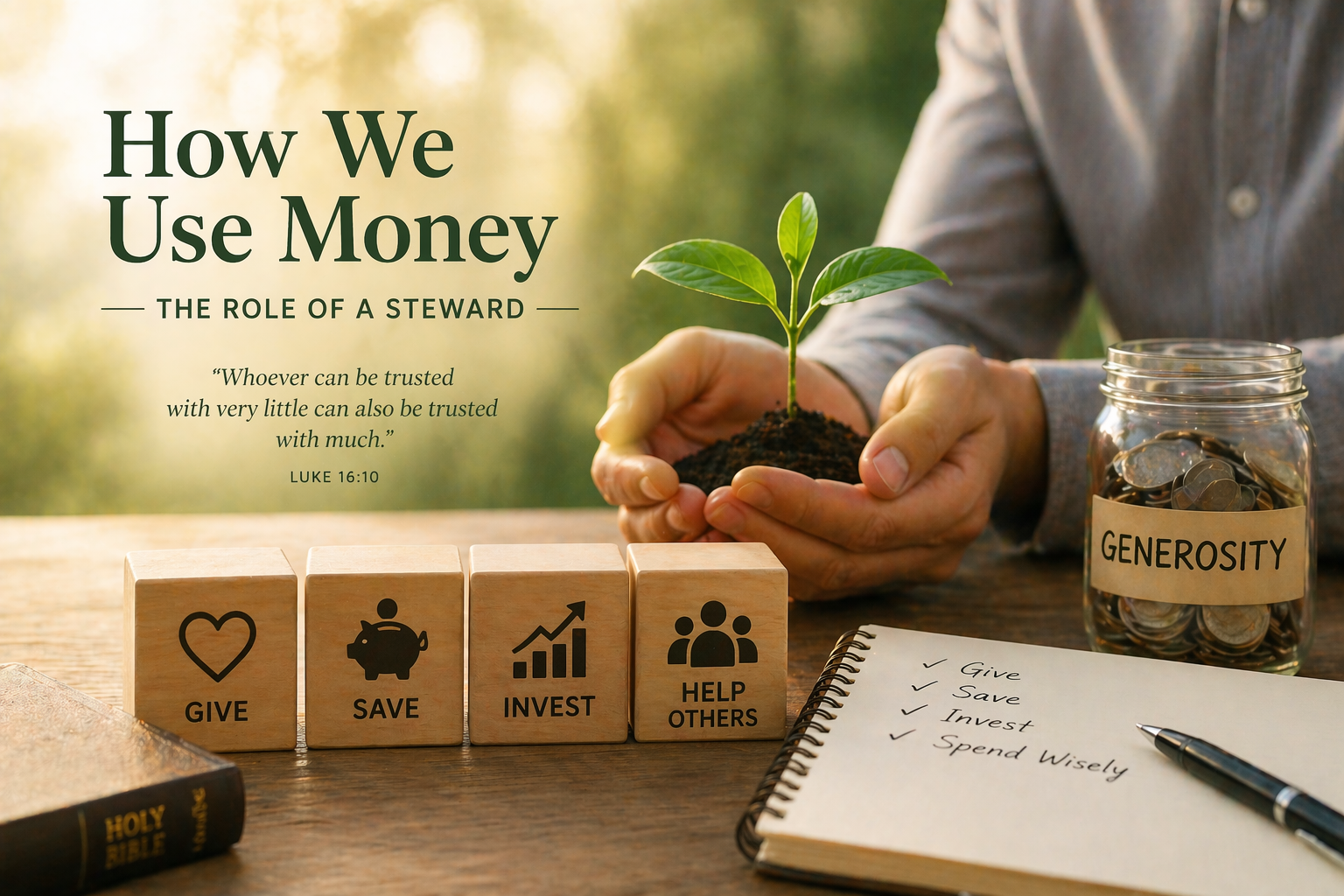
So, how should we use money?
From a faith perspective, we are stewards of money. Money does not truly belong to us—it is entrusted to us by God. Therefore, we are responsible for managing it wisely.
Of course, we should not waste money. This is a basic principle that most people understand. However, in real life, especially in North America, we often see many families struggling with overspending.
On the other hand, saving money is not wrong. But when someone becomes a “slave to money,” it becomes a problem. When a person is unwilling to spend even a small amount, they lose sight of the true purpose of money.
The Bible tells a story of a rich man who stored up great wealth and planned to build bigger barns to store even more. But God told him that his life would end that very night—so what would happen to his wealth? (Luke 12:16–21). This reminds us that simply accumulating wealth without using it properly has no real meaning.
God gives us resources not just to store them, but to use them appropriately—to meet our needs, enjoy His creation, and help others.
Through my work, I have seen many different families. I have learned that there is no single correct way to use money. Some families focus on taking care of their own household, which is already a responsible and meaningful use of resources.
Others have the ability to do more, such as supporting relatives or paying for education to create better opportunities for the next generation. I have also seen seniors plan their assets and set up charitable funds to support causes they care about.
For myself, as a parent, I naturally focus more on helping children. Through my work, I also meet many families with special needs, which has shaped how I think about using resources.
Therefore, we must learn balance in using money—not wasting it, and not being controlled by it, but being faithful and wise stewards under God’s guidance.
Conclusion
In society, people often judge others based on wealth, leading to attitudes such as envy of the rich or disrespect toward the poor. However, a person’s value is not determined by how much money they have. There are good and bad people among both the rich and the poor.
Similarly, we should not judge people by their profession. There is no “high” or “low” job. As long as a person works according to biblical principles, with honesty and integrity, whether they are a lawyer, doctor, teacher, firefighter, or even someone serving in church, they are worthy of respect.
As Christians, our focus should be on whether we are living according to God’s will. When we handle money—both earning and using it—based on biblical principles, and live with integrity and love, this becomes a testimony of our faith.
Disclaimer:
The comments contained herein are a general discussion of certain issues intended as general information only and should not be relied upon as investment, financial, legal, accounting or tax advice. Please obtain independent professional advice, in the context of your particular circumstances. This newsletter was written, designed and produced by Samuel Li for the benefit of Samuel who is Advisors at : SamuelConsultant.com is a registered trade name with Investia Financial Services Inc., and does not necessarily reflect the opinion of Investia Financial Services Inc. The information contained in this article comes from sources we believe reliable, but we cannot guarantee its accuracy or reliability. The opinions expressed are based on an analysis and interpretation dating from the date of publication and are subject to change without notice. Furthermore, they do not constitute an offer or solicitation to buy or sell any securities.
Mutual Funds, approved exempt market products and/or exchange traded funds are offered through Investia Financial Services Inc.
Commissions, trailing commissions, management fees and expenses all may be associated with mutual fund investments. Please read the simplified prospectus before investing. Mutual funds are not guaranteed and are not covered by the Canada Deposit Insurance Corporation or by any other government deposit insurer. There can be no assurances that the fund will be able to maintain its net asset value per security at a constant amount or that the full amount of your investment in the fund will be returned to you. Fund values change frequently and past performance may not be repeated. Investia is not liable and/or responsible for any non mutual fund related business and/or services.